

D3 Morpheus
The Accountable Agentic SOC Platform
Morpheus autonomously triages, investigates, and responds across the full alert lifecycle, governed at every stage, every verdict graded by its evidence, every step on one traceable record. When Morpheus is uncertain, it defers to a human. And the AI is in the price, not on a meter.
Noise Down, Security Up.
Built for Fortune 500 SOCs and the world’s largest MSSPs.



Attack Path Discovery
Attack Path Discovery
Morpheus is the agentic SOC platform that triages, investigates, and orchestrates governed response on every alert, without forcing a tradeoff between autonomy and accountability.
Attack Path Discovery, D3’s investigation engine, traces every alert across identities, endpoints, cloud, and email infrastructure. It maps blast radius, correlates evidence, and drafts context-aware remediation in minutes. Work that takes a senior analyst hours.
Bounded agentic reasoning that’s explainable, governable, and reversible. One engine, not a fleet of AI agents to reconcile. Defensible under SEC, NYDFS, HIPAA, NIS2, DORA, and the EU AI Act.
What does Attack Path Discovery do on every alert?
It traces the alert across identities, endpoints, cloud, and email infrastructure, maps blast radius, validates IOCs, and drafts remediation before an analyst opens the case.
Verified Verdicts
How do you know when an agentic SOC’s verdict deserves your trust?
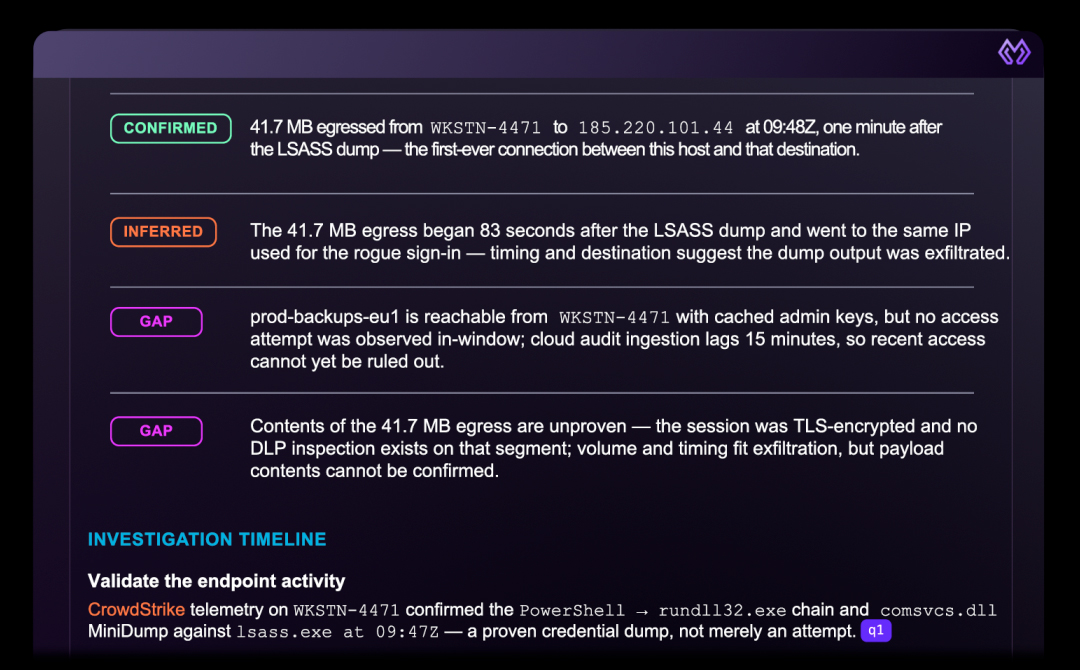
Every Morpheus finding is graded by evidence quality: Confirmed, Inferred, or Gap. The reasoning behind every grade is readable and correctable, so a mistake fixed once stays fixed.
Confirmed
Source telemetry attached
The source telemetry is attached. You can read it.
Inferred
Reasoning shown
The reasoning is shown. The evidence is circumstantial, and Morpheus says so.
Gap
Nothing found, and it says so
Morpheus looked, found nothing, and reports the gap instead of filling it.
“Because I can check everything Morpheus does, I can hand it more work.”
Sr. SOC Analyst, Security Services Provider
THE PLATFORM
The full capability stack, under one engine, one trail.
Most enterprises buy three or four of these from different vendors and pay engineers to make them talk to each other. Morpheus ships them as one platform. One engine. One audit trail. One procurement decision instead of four.
| Capability | What it does in Morpheus | Where it lives elsewhere |
|---|---|---|
| Verified Verdicts | Every finding graded Confirmed, Inferred, or Gap, evidence attached, reasoning readable and correctable. | Not offered. Most AI SOC tools return a confidence score. |
| AI SOC | L1 and L2 investigation run end to end on every alert, up to 95% in under two minutes. | Point tool, triage only, hands off to your SOAR. |
| SOAR | Deterministic playbook engine with approval gates, same lineage as legacy SOAR. | Separate platform, separate audit trail. |
| Case management | One incident record across triage, investigation, response, and evidence. | ITSM or a second SOC tool. |
| Self-healing integrations | 800+ connectors that repair themselves when vendors change APIs. 18-minute production MTTR on drift. | Engineering backlog. |
| Vulnerability triage | The same investigation engine applied to scanner and AI-discovered findings. | Separate vendor. |
| Governance and audit | Four autonomy modes, one audit trail per incident, evidence for SEC, NYDFS, HIPAA, NIS2, DORA, EU AI Act. | Screenshots. |
The Outcomes
What changes when every alert gets investigated.
The numbers a SOC director at a 10,000-employee enterprise can hold us to.
Improved Alert Coverage
Every alert investigated to L2 depth, not just the criticals.
Accelerated Investigations
Up to 95% of alerts reach a graded verdict in under two minutes. Customer-reported production data, July 2026.
Evidence-backed Verdicts
Every finding graded, source telemetry attached. You know what’s proven before you act.
One audit trail Per Incident
Triage, investigation, response, and case notes on one record, whether a playbook or an Agentic Task acted.
Self-healing Connectors
800+ integrations that repair themselves when a vendor breaks an API. The SOAR maintenance tax stops accruing.
Accountable Autonomy
Never guesses, never bluffs, always fails to the human. When Morpheus can’t confirm a finding, it grades it Gap and hands the alert to an analyst.
Autonomy Modes
Pick how much Morpheus does on its own.
What are the four autonomy modes?
Deterministic, AI-Assisted, AI-Led, and Autonomous: four settings on one engine with one audit trail, chosen per use case and changed by configuration.
Deterministic
Human writes the rules
Rule-based playbooks run end to end. No AI in the chain.
AI-Assisted
Human in every action
Morpheus investigates and recommends. Your analyst approves every step.
AI-Led
Human at sign-off
Morpheus investigates and drafts the response. You sign off; response runs.
Autonomous
Human at design time
Investigation and response at AI speed. Gates set at design time. Roll back any action.
One reasoning engine, not a mesh of agents.
Why does Morpheus run one reasoning engine instead of a mesh of agents?
Because you shouldn’t have to reconstruct what your AI did. Most agentic SOC platforms run a fleet of specialized agents, one for triage, one for enrichment, one for correlation, one for response, passing context between each other on every alert. When the verdict comes back, the reasoning is spread across four agent logs. A fabrication in one infects every agent downstream, and by the time it reaches you it looks like consensus.
Morpheus runs the same agentic reasoning under one engine, inside one deterministic playbook, with hard bounds on iteration, cost, tool scope, and approval. What that means at your desk:
One log to read. The whole investigation is one record, in order. Nothing to stitch together after the fact.
One thing to trust. You verify one reasoning chain, not five. A correction you make holds everywhere, because there’s only one place to make it.
Case management that just works. Investigation, response, and evidence land in the same case because they came from the same engine. No integration between your AI and your case system, because there isn’t a seam.
That’s also what makes a verdict gradeable. You can only attach evidence to a finding when one system produced both.
Turn Agentic SOC Into Measurable Results
Seven measurements that prove the investment: coverage, investigation time, verdict trust, the human factor, integration health, audit response, and autonomy granted. Each with a baseline method and a 90-day target.
Read the brief →Notice for Cortex XSOAR customers, September 2026
Every XSOAR renewal is now a migration decision.
Palo Alto names Cortex AgentiX “the next generation of Cortex XSOAR”
XSOAR professional-services SKUs reach end-of-sale
XSOAR 6.12 and 6.13 reach end-of-life
XSOAR still ships, and it isn’t end-of-life. But the next product runs on a new tenant, a new data model, and a metered licence, with no published migration guide as of August 2026. You’re migrating either way. The XSOAR Exit Program makes it ours to do and yours to control.
We convert your playbooks.
Like-for-like, with a diff you can read.
Your stack stays put.
SIEM, EDR, identity, ticketing, unchanged.
No double payment.
Billing starts when your XSOAR contract ends.
No risk of a failed migration.
XSOAR stays live. You cut over only when it passes your acceptance criteria.
Cortex AgentiX vs Morpheus, Exit Program terms, For MSSPs
Running Splunk SOAR, Swimlane, Torq, or Tines? The Legacy SOAR Migration Program covers those too. Same conversion, same parallel run, same sign-off.
faqs
Common questions, answered.
Is Morpheus an AI SOC platform, an autonomous SOC, or an agentic SOC platform?
Morpheus is an agentic SOC platform. It’s the precise term for what the category has been calling “AI SOC” and “autonomous SOC”: alert handling done with a degree of independence, under governance a human sets. An AI SOC platform describes the technology. An autonomous SOC describes the goal. An agentic SOC platform describes how the work actually gets done: software that investigates, decides, and acts, with a human setting the limits and able to check every result. For teams leaving legacy SOAR, Morpheus is the SOAR alternative that keeps deterministic playbooks and adds the agentic layer on the same engine.
How does Morpheus grade its verdicts?
Every finding is graded by evidence quality. Confirmed means the source telemetry is attached. Inferred means the reasoning is shown and the evidence is circumstantial. Gap means Morpheus looked, found nothing, and says so rather than filling the gap. The reasoning behind each grade is readable and correctable, and a correction persists across future investigations.
How is Morpheus different from SOAR?
SOAR automates predefined steps; Morpheus produces investigation conclusions. SOAR enriches alerts and hands them off; Morpheus runs L1 and L2 investigation end to end and drafts the remediation. SOAR integrations need constant maintenance; Morpheus integrations self-heal when vendors push API changes. Morpheus is built on a SOAR-class deterministic engine, so existing SOAR processes, integrations, and case data migrate rather than getting thrown away.
How is Morpheus different from multi-agent AI SOC platforms?
Those platforms run multiple specialized agents that coordinate through message buses or shared memory, which introduces coordination latency, context fragmentation, hallucination propagation across agents, and an audit trail split across agents. Morpheus runs bounded agentic reasoning inside one deterministic playbook with explicit iteration, cost, tool-scope, and approval-gate bounds. One engine. One reasoning context. One audit trail per incident.
What is Attack Path Discovery?
Attack Path Discovery (APD) is D3’s investigation engine. On every alert, APD traces the attack across identities, endpoints, cloud, and email infrastructure, maps blast radius, identifies the chain of techniques mapped to MITRE ATT&CK, and drafts remediation. APD is read-only by design. The investigation produces context. The action layer is governed by your chosen autonomy mode.
Does Morpheus work with my existing security stack?
Yes. Morpheus integrates with 800+ tools across SIEM, EDR, XDR, IAM, cloud, email, NDR, DLP, and ITSM, including Microsoft Sentinel, Defender, Splunk, CrowdStrike Falcon, SentinelOne, Palo Alto Cortex, Okta, and ServiceNow. Integrations are self-healing: when a vendor pushes a breaking API change, Morpheus adapts the connector automatically. Production drift repair runs at 18 minutes MTTR vs 4 to 6 weeks.
Is Cortex XSOAR being discontinued?
No. XSOAR has no product-wide end-of-life notice and XSOAR 8 still ships. Palo Alto has named Cortex AgentiX as XSOAR’s next generation (Oct 28, 2025), ended sale of the XSOAR professional-services SKUs (Feb 1, 2026), and retired XSOAR 6.12 and 6.13 (Jun 30, 2026). D3 runs an XSOAR Exit Program for customers deciding what comes next.
How long does deployment take?
Days, not months. Integrations connect, the deterministic playbook engine runs, APD investigates from day one. Over the following weeks, the self-learning pipeline tunes confidence scoring to your alert volume and recommendations to what your analysts actually act on. Day-one functionality is real; peak accuracy compounds over the first 60 to 90 days.
Does Morpheus support MSSPs?
Multi-tenant by design. Per-tenant policies, per-tenant SLAs, per-tenant autonomy modes, per-tenant audit trails. Self-healing integrations propagate vendor API changes across every tenant simultaneously, decoupling engineering maintenance from client scale. Built for the world’s largest MSSPs.
How is Morpheus priced?
Annual subscription, sized by your alert volume envelope. The AI is included: no token costs, no usage meter, no month-end compute surprise. Above the envelope, additional alerts are priced per alert, published in advance. Talk to us and we’ll size an envelope to your environment and tenant structure.
Cortex, XSOAR and AgentiX are trademarks of Palo Alto Networks, Inc. D3 Security is not affiliated with Palo Alto Networks.